If you don't consider this in your marketing strategy, you are doing it wrong
👉 Improve your brand plan with one simple tactic successful Pharma marketing executives are leveraging
Most Pharma marketing teams are implementing a 5 steps strategy, but are missing the 6th (yet the most important) 🫠

Step 1: Emphasizing the efficacy of your product
📝 Provide scientific data: Heavily market the efficacy and effectiveness of your product based on scientific data. This can include results from clinical trials, post-authorization studies, and other research (such as direct-to-patients insights studies) that shows the effectiveness of your product and differentiators vs competition
🎤 Use testimonials: Share testimonials from patients or healthcare providers who have used your product and experienced positive results. This can be a powerful way to show the effectiveness of your product in a real-world setting
📌 Highlight unique features: Emphasize the unique features of your product that make it more effective than other options already available on the market. This can include a novel mechanism of action, a targeted delivery system, or an improved safety profile
⚖️ Use comparative data: Compare your product to other options on the market and highlight how it outperforms them in terms of efficacy. This can be done through head-to-head clinical trials or by highlighting key differences in product profiles
Step 2: Targeting HCPs
👀 Develop targeted campaigns: Develop targeted marketing campaigns that are designed to reach prescribers specifically. This can include targeted digital advertising, direct mail campaigns, and targeted events
💻 Use data analytics: Use data analytics to identify prescriber behavior patterns and preferences. This can help you create more effective marketing campaigns that are tailored to their needs and preferences
👨⚕️ Leverage thought leaders: Partner with key opinion leaders in the field who have a strong influence over prescriber behavior. These thought leaders can help promote your product and increase its visibility among prescribers and their peers
🚕 Attend industry events: Attend industry events and conferences where prescribers are likely to be present. This can give you an opportunity to network with prescribers and promote your product directly to them
📚 Offer education and training: Offer education and training to prescribers to help them better understand your product and its benefits. This can help build trust and credibility with prescribers, which can lead to more prescriptions being written
Step 3: Providing Patient Support Programs (PSPs)
🤒 Identify patient needs: Start by identifying the needs of the patient population that you are serving and supporting. This can include understanding their disease state, treatment options, and potential barriers to treatment adherence. Don’t forget to target a broad and representative sample to make sure you identify all your targeted patients’ needs (not only the needs of patients part of panels)
🤝 Develop a comprehensive program: Develop a comprehensive PSP that addresses the needs of patients throughout their treatment journey. This can include things like patient education, financial assistance, and ongoing support
📱 Leverage technology: Use technology to make it easier for patients to access support resources. This can include online portals, mobile apps, and other digital tools that make it easy for patients to access information and support
👩🔬 Collaborate with healthcare providers: Collaborate with HCPs to ensure that patients are receiving the support they need. This can include working with providers to identify patients who may need additional support and collaborating on treatment plans to ensure that patients are receiving the best possible care
📊 Continuously evaluate and improve: Continuously evaluate and improve your PSP based on patient feedback and program metrics. This can help ensure that your program is meeting the needs of patients and delivering the best possible outcomes
Step 4: Leveraging Digital Marketing
👂 Understand your audience: Understand your target audience and what digital channels they use to access information. This can help you develop targeted digital campaigns that reach your audience where they are. Don’t forget that even if your targeted patient population are elderly patients, they are online!
🔓 Use multiple channels: Use multiple digital channels to reach your audience, including email, social media, search engine marketing, and display advertising. This can help you reach a larger audience and ensure that your message is seen by the right people at the right time
🤩 Develop engaging content: Develop engaging and informative content that resonates with your target audience. This can include things like videos, infographics, blog posts, and social media posts
💻 Leverage data analytics: Use data analytics to track the performance of your digital marketing campaigns and make data-driven decisions about how to optimize your efforts. This can include things like monitoring website traffic, email open rates, and click-through rates to understand how your audience is engaging with your content
🔭 Embrace innovation: Embrace new and emerging technologies to stay ahead of the curve in the digital marketing landscape. This can include things like chatbots, virtual reality experiences, and other innovative approaches to digital marketing
Step 5: Collaboration with Patient Advocacy Groups (PAGs)
🤝 Identify common goals: Identify common goals between your organization and the patient advocacy group. This can include things like increasing awareness of a disease, improving patient outcomes, or advocating for policy changes that benefit patients
💪 Understand their mission and values: Take the time to understand the mission and values of the patient advocacy group you are collaborating with. This can help you tailor your messaging and approach to align with their goals and values
🎩 Be transparent: Be transparent about your organization's goals and objectives when collaborating with patient advocacy groups. This can help build trust and credibility with the group and ensure that everyone is on the same page
🗝 Provide resources: Provide resources to patient advocacy groups to help them achieve their goals. This can include things like funding for events or programs, access to medical experts, or educational materials
👂 Listen and learn: Listen to the needs and concerns of patient advocacy groups and learn from their experiences. This can help you develop more effective strategies for engaging with patients and advocating for their needs
👏 Respect their autonomy: Respect the autonomy of patient advocacy groups and avoid trying to exert undue influence over their activities or messaging. Instead, work collaboratively to achieve common goals and support the needs of patients
Step 6: Thinking TRUE patient engagement
Pharma marketing teams that are over achieving their objectives are focusing on patients that are not engaged yet.
It’s one thing to engage with your prescribers but what if your eligible patients are simply not visiting them?
Think about those patients that are not part of a PAGs, not being prescribed the right treatment yet (and thus can't be enrolled in a patient support program), not consulting HCPs and still struggling with symptoms.
They need you and your attention!
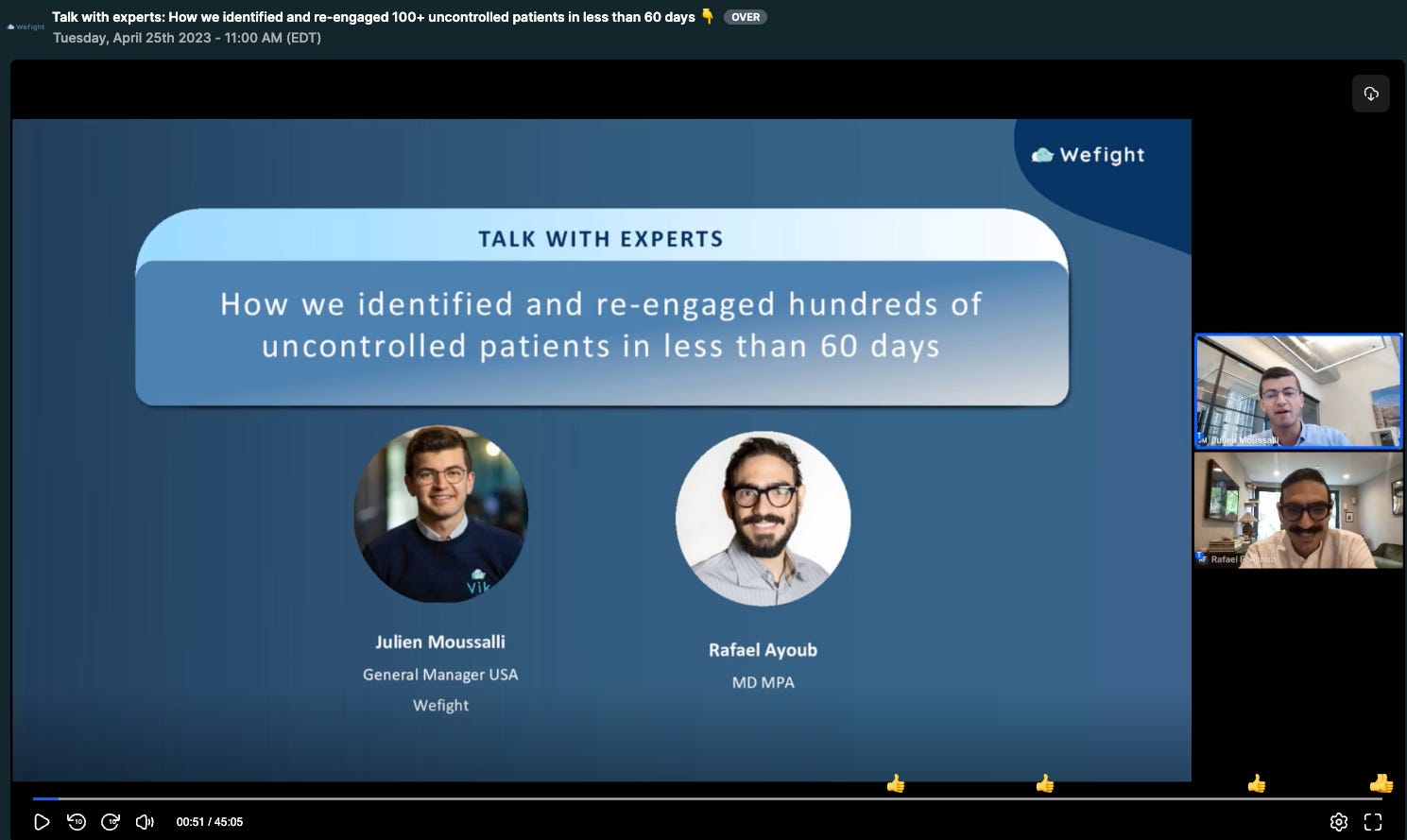
In our latest webinar, we discussed how we activated and converted uncontrolled patients with our unique methodology.
We know that your priority for 2023 is to drive more of your eligible patients to visit your prescribers. Building activation campaigns is thus a must if you want to target patient populations to guide them to the physician.
We did exactly that. In less than 60 days, we converted hundreds of uncontrolled atopic dermatitis patients in the United States. But we went above and beyond. After consulting with an HCP, more than 95% gave us post-appointment information.
This activation and conversion campaign identifies at-risk and uncontrolled patients, helping to reduce therapeutic inertia, drive prescriptions and reduce healthcare costs. It’s based on a model replicated last year across 9 countries in EU5, LATAM, and GG, and resulted in thousands of converted patients.
Click on the below link to access the record of our webinar and learn about patient conversion and why it should be a priority in your medico-marketing strategy 👇